

Baptism in Islam?
My First Experience of a Christian Baptism:
A Muslim Perspective
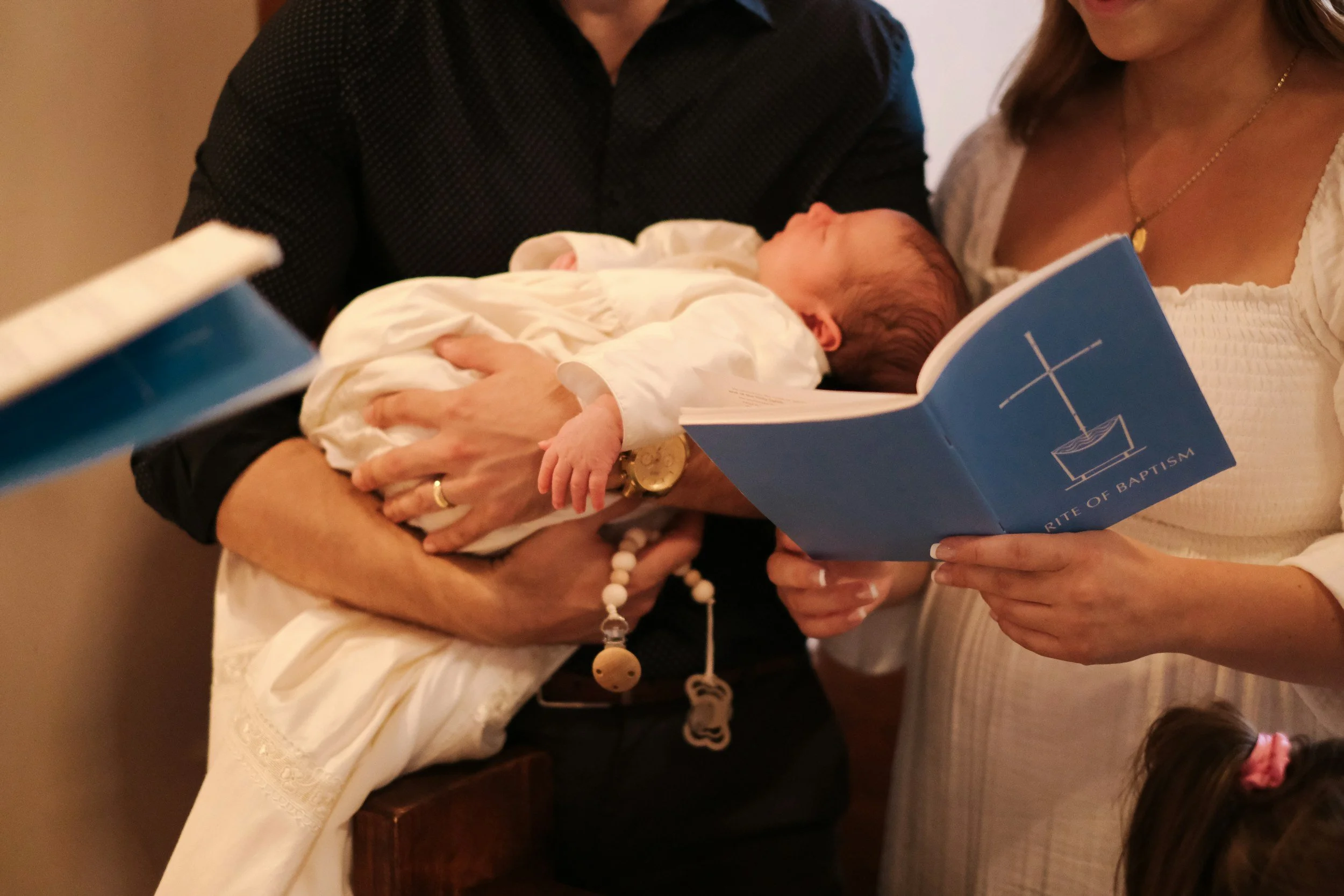
Recently, I was invited for the first time to attend a Christian baptism (Taufe) in a church in Germany. As someone interested in religion and intercultural dialogue, the experience was not only an opportunity to witness an important Christian ritual, but also to reflect on some traditions and practices found in Islamic culture.
Before attending, I had a rather different picture in my mind. I imagined that the priest would take the child and dip him directly into the water. I had previously read about the baptism of Jesus by John the Baptist in the Jordan River, so I was quite curious to see how the ceremony would take place with a child of about two years old. I also wondered how the priest and the parents would manage to keep such a young child calm. Could it even be dangerous for such a small child?
What I witnessed, however, was quite different from what I had imagined.
The child was not immersed in water. Instead, the water was used symbolically. The priest dipped his hand into the water and placed it on the child's head and forehead while saying the well-known Christian words: “In the name of the Father, and of the Son, and of the Holy Spirit.”
The parents also had an important role in the ceremony, together with the Pateneltern, or godparents. This was particularly interesting to me because having godparents in this religious and social sense does not have a direct equivalent in Islamic culture. Islamic culture also does not have a baptismal ceremony through which a child formally becomes Muslim.
Water, Life and Symbolism
One of the things that attracted my attention most was the use of water. Water is not simply a physical element in the ceremony; it carries symbolic meanings connected with life, renewal and blessing. This made me think about the importance of water in Islamic culture as well.
Water is essential for human life. Without water, human beings cannot survive. In Islamic culture, water also has an important place in religious practices such as wuḍūʾ (ablution) and ghusl (ritual washing), where it is connected with cleanliness, purity and preparation for worship.
This led me, as a researcher of Islamic Studies, to ask myself: Do Muslims have something comparable to baptism?
At first, my answer would have been: No.
There is no baptism in Islamic culture through which a child becomes Muslim. Muslims traditionally believe that children are born upon the fiṭra—a natural disposition associated with an innate orientation toward God. But thinking about the baptism ceremony made me remember several traditions associated with newborn children in Muslim societies.
What Happens When a Child Is Born in Islamic Culture?
One well-known practice in many Muslim communities is to recite the adhān, the call to prayer, softly into the newborn's ear. The idea is that among the first words the child hears are words referring to God, faith and prayer.
This is clearly different from baptism. According to the traditional Islamic understanding, a child does not need a religious ceremony or an imam to become part of the Muslim community. Muslims traditionally believe that every child is born upon the fiṭra, a natural disposition created by God. It refers to the human being’s innate inclination toward God and the recognition of Him. Therefore, a newborn is not considered to need conversion or baptism. Religious identity is understood to develop later through the family and the surrounding society.
There are also other practices associated with childhood in Islamic cultures, such as circumcision, which in many Muslim traditions is connected with purity and with traditions associated with the Prophet Abraham. I would not describe circumcision as an “Islamic baptism,” since that would be an inaccurate comparison. Rather, it is another example of a religious or traditional, practice connected with an important stage of life.
What About the End of Life?
Interestingly, the baptism experience also made me think about the opposite moment: the end of life. In Islamic culture, Muslims consider the shahāda, or declaration of faith, to be the central expression of Islamic belief: “I bear witness that there is no god but God, and that Muhammad is the Messenger of God.”
«أشهد أن لا إله إلا الله، وأشهد أن محمدًا رسول الله.»
The shahāda is also associated with the final moments of life. Traditionally, Muslims may remind a dying person of it, and many Muslims hope that the shahāda will be among the last words they are able to say.
In this sense, we can see religious practices surrounding different stages of life in Islamic culture: the adhān at birth, practices connected with childhood and purity, and the shahāda at the end of life.
This does not mean, however, that these practices are equivalent to Christian baptism. Their meanings, theological foundations and contexts are different.
Another important difference is that these practices in Islamic culture do not necessarily require an imam or take place in a mosque as a formal religious ceremony. Baptism, by contrast, is a Christian ritual normally performed by a priest within a church.
What Did I Learn from the Experience?
Perhaps what interested me most about my first experience of baptism was not simply the ceremony itself, but what it made me think about afterwards. I entered the church expecting to see something completely unfamiliar. Yet I found myself thinking about themes that are also familiar in Islamic culture: water, life, blessing, purity, community, faith and the different stages of human life.
This does not mean that baptism and Islamic practices are the same, nor that they have the same religious or theological meanings. Each tradition has its own context and interpretation. But the experience showed me something important about interreligious and intercultural dialogue. Understanding another religion does not necessarily mean looking for an identical practice in one's own tradition. Sometimes, it simply begins with asking:
What does this ritual mean to the people who practice it?
For me, attending a Christian baptism (Taufe) for the first time was therefore much more than simply witnessing a ceremony in a church. I went out of curiosity, but I left thinking not only about what I had seen, but also about some of the traditions within Islamic culture that I had perhaps never looked at from quite the same perspective.
Perhaps this is one of the most valuable aspects of intercultural and interreligious dialogue: learning about other traditions can help us understand them better, while also encouraging us to look at our own traditions with fresh eyes.
Thank you to everyone who reads with interest and remains open-minded – it truly means a lot to me. Feel free to share your thoughts and experiences; I look forward to the exchange! 🙂 Ma’assalama (goodbye) 🌙✨
P.S. The text was corrected with the help of AI, but the content and ideas are entirely my own.
Ragab Kamal Abouhalima, Philipps-Universität Marburg. Germany
Ragab Kamal Abouhalima



My First Experience of a Christian Baptism: A Muslim Perspective